


Why Guest Experience and Restaurant Operations Must Transform Together
Restaurant brands are creating more sophisticated guest experiences every day. But every new experience creates something the restaurant has to deliver.
A personalized offer has to be fulfilled. A recommendation needs to reflect what’s actually
available. Voice ordering has to work during the lunch rush. And an upsell isn’t much of a win if it
slows down the kitchen or drive-thru.
That’s why guest experience and restaurant operations need to be designed together. What we
ask a guest to see, buy or do has a direct impact on what happens on the other side of the counter.
The best experience isn’t simply one the guest responds to. It’s one the restaurant can deliver consistently and profitably at scale.
Design the Experience and the Operational Response Together
Restaurant transformation often happens one channel at a time. Mobile has a roadmap. Loyalty has
a roadmap. Drive-thru has a roadmap. Kiosks and digital menu boards may sit somewhere else entirely.
That may make sense inside the organization, but the guest experiences one brand. Each touchpoint should have a clear job, whether that’s helping the guest decide faster, introducing a new product, increasing attachment or making ordering easier.
But influencing guest behavior is only half the job. You also have to think about what happens in the restaurant as a result. If a recommendation increases attachment, what does that do to kitchen capacity and throughput? If personalization shifts demand, can the operation respond?
The environment matters too. What works in an app may not work the same way on a kiosk, indoor menu or drive-thru display. Guests have different amounts of time and attention in each setting, and the restaurant has different operational constraints.
Even a simple change can have a ripple effect. A promotion may add ingredients, consume line production capacity, or training. A menu redesign can shift demand toward items that take longer to prepare. An upsell can lose its value if it slows throughput or adds too much complexity.
Before an experience launches, teams should understand the impact on speed, accuracy, capacity, margin and employee workflows, including what happens when an item is unavailable or conditions change.
If we’re trying to change what the guest does, we need to be ready for what the restaurant has to do next.
Design Around Behavior, Not Assumptions
Every digital touchpoint should have a clear purpose. It might help a guest decide faster, make customization easier, surface a relevant offer or help the restaurant manage demand.
The real measure is what changes. Are guests finding what they need faster or discovering products they might otherwise miss? Are attachment and mix improving without adding
friction?
Then look at what happened in the restaurant. Did speed or accuracy change? Did the promoted mix put more pressure on the kitchen? Was the experience easier or harder for restaurant teams to support?
This is where Experience Intelligence comes in. By combining behavioral observation, testing and operational and sales data, brands can see what guests actually notice and do, understand the impact on the restaurant, and refine the experience before scaling it.
The goal isn’t more data. It’s better decisions. Proof-of-play can tell you that content appeared. It can’t tell you whether the guest noticed it, acted on it or whether it produced the intended result.
Connect the Guest Experience to What’s Happening in
the Restaurant
A connected experience depends on good information. Pricing, availability, menu data, loyalty and restaurant conditions all influence what a guest should see. When that information isn’t connected, brands risk promoting unavailable items, showing conflicting information or making recommendations the restaurant can’t efficiently fulfill.
AI, voice ordering and automated decisioning raise the stakes. A recommendation should account for both the guest and what’s happening in the restaurant at that moment. Otherwise, we’re simply making disconnected decisions faster.
The goal isn’t perfect integration. It’s a better experience: fewer contradictions, faster updates and decisions that make sense for both the guest and the operation.
Pilot for Reality, Not Just for Presentation
A collaborative perspective from Creative Realities and Point B



Share this
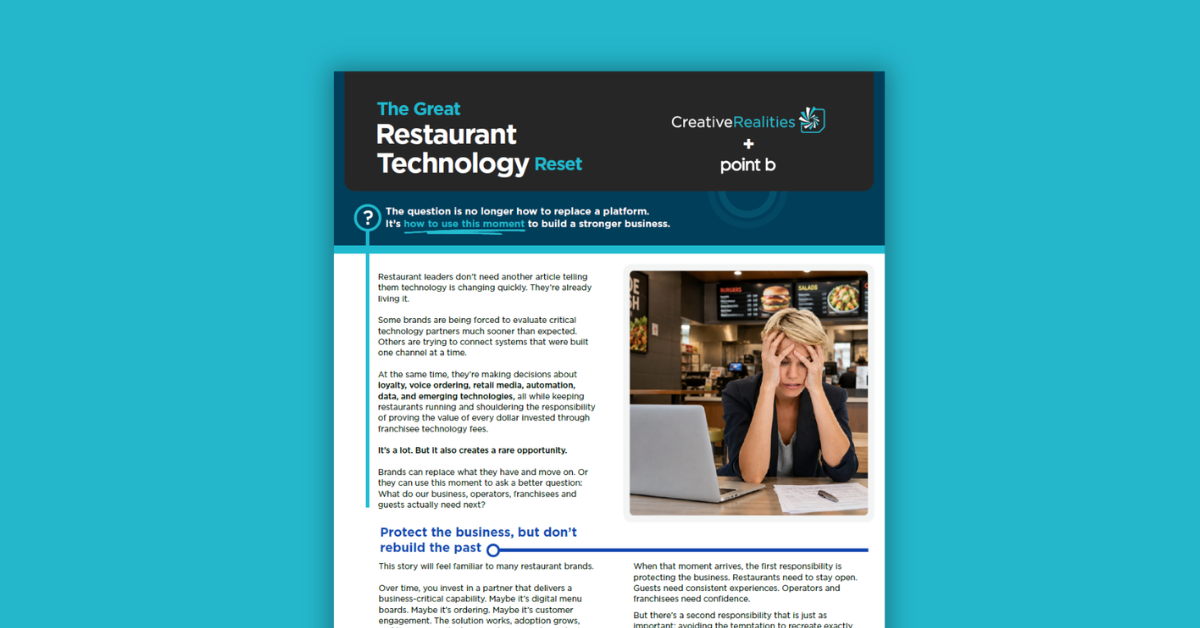
The Great Restaurant Technology Reset

Turn Every Fan Moment into Revenue: The Power of Real-Time Digital Activations