Digital signage has long helped retailers guide shoppers, promote products, and enhance the in-store experience. Those same screens are now evolving into something more valuable—automated, monetizable media inventory that brands can plan, target, and optimize in near real time.
When Walmart Connect announced roughly 160,000 in-store screens across more than 4,600 locations, in its 2024 industry announcement, it signaled that in-store digital inventory has reached national scale. Analysts from Grand View Research project that programmatic digital out-of-home advertising will expand from approximately $900 million in 2023 to more than $6 billion by 2030, growing at a rate of over 31% annually.
All of this is signaling that the technology, budgets, infrastructure, and audience data are finally aligning to make automated advertising inside the store a reality. Here's what you need to know.
Why Now? Three Forces Converging
Momentum behind in-store programmatic didn't appear overnight. It's the result of three developments that collectively make automated ad buying practical and measurable.
- Standards and trust are finally in place: The IAB and Media Rating Council have introduced Retail Media Measurement Guidelines that include in-store definitions for impressions, viewability, and attribution. With clearer benchmarks, retailers and advertisers can compare in-store media with digital channels using consistent KPIs.
- Programmatic infrastructure has caught up: Digital out-of-home (DOOH) is now widely integrated into OpenRTB standards across major SSPs and exchanges, the industry standard for real-time bidding. That standardization erases much of the custom integration that once stood in the way of adoption, allowing planners to control in-store screens through the same platform they already use for display, mobile, or connected TV campaigns.
- Retailers are activating their networks: Big retail media networks, such as Walmart Connect, Kroger Precision Marketing, and other major retailers are exploring ways to connect in-store digital displays with shopper data to create measurable media products. The more retailers activate their data and infrastructure, the more buyers have scalable access to large audiences at the point of decision.
Each of these would be significant on its own; collectively, they're the reason that in-store programmatic advertising is becoming sustainable and scalable.
What 'Programmatic in Aisles' Actually Means
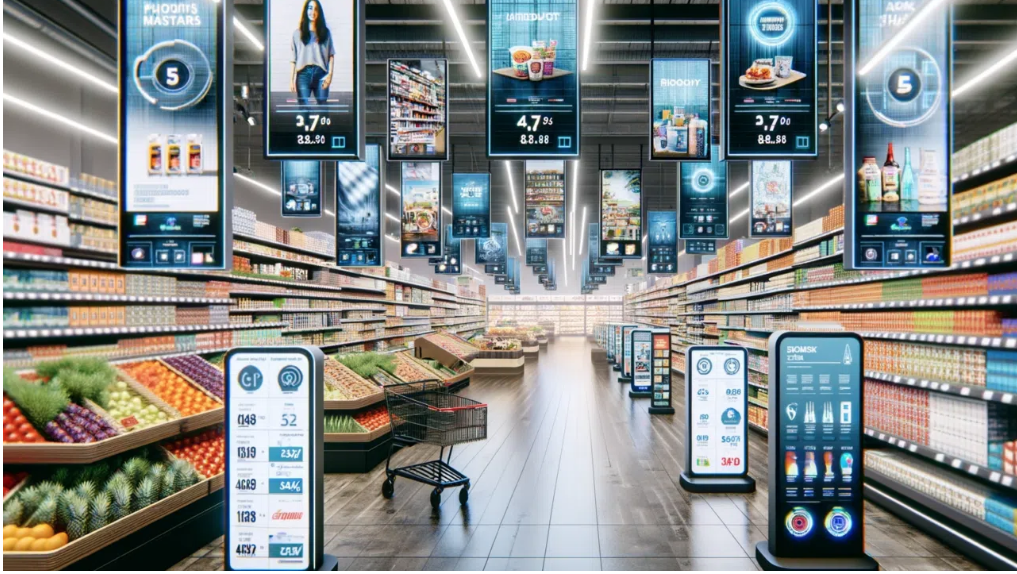
Programmatic in-store advertising introduces digital automation into the physical world. Rather than pre-reserving fixed loops weeks in advance, ad space is made available to demand-side platforms (DSPs) through supply-side platforms (SSPs), where advertisers bid for impressions according to their targeting needs. Winning creatives are served in real-time on the proper screen and zone—entrance, aisle, endcap, or checkout—according to logic rules that keep key store content intact and allow operational content always to override.
What is so captivating about this change is that it can be so responsive. Systems now draw on multiple live signals from the store environment:
- Inventory levels: Remove ads for out-of-stock products or highlight overstock goods.
- Promotion windows: Start and stop creatives in sync with current offers.
- Weather and events: Promote contextual items like umbrellas before impending storms or jersey items on game day.
- Store traffic patterns: Adjust messaging for peak hours versus off-peak hours.
These signals enable campaigns to self-optimize while adapting to the store's operating priorities. The outcome is a real-time, dynamic media layer that reflects actual conditions instead of rigid schedules or static assumptions.
The Retailer Point of View: Monetize Without Disrupting Ops
If you're a retailer, the challenge is striking a balance between monetization and operational discipline. Every screen must still fulfill core duties, such as displaying pricing, compliance notices, or service updates, while introducing new advertising responsibly.
Screen size and zoning rules can help avoid operational content from being encroached upon by advertisements. An operation can hold endcap and queue-line screens for paid advertising and retain shelf-edge screens to report pricing and promotions. Clear boundaries enable operations and advertising to coexist peacefully without problematic overlap.
The shift to digital shelf labels provides yet another degree of responsiveness. As automated price adjustments are executed within tens of thousands of stores, emerging integrations with digital shelf labels could enable live pricing synchronization in the future. Ads can subsequently sync in real time with store-level promotions, liberating store staff from manual updates and facilitating consistency store-to-store.
Data governance is just as critical. You have to maintain trust while using data responsibly. That means relying on aggregated, privacy-safe store partners such as BlueZoo or Quividi, and not individual identifiers. This approach continues to target compliance while still providing valuable performance insights. Note that CRI platforms do not collect or store personally identifiable information. All data used for optimization is aggregated and anonymized.
When executed correctly, programmatic can become additive: screens stay compliant, operations stay streamlined, and incremental revenue flows through an existing network.
The Advertiser Perspective: Why It Belongs in the Media Plan
For advertisers, in-store programmatic is the natural next step in omnichannel media. It enables campaigns to reach consumers in the physical world with the same precision and accountability that can already be achieved with standard digital channels.
In-store screens provide both scale and context. Retailers now offer networks of thousands of in-store connected displays that function like any other programmatic asset, but within an in-person environment where purchase decisions are made. Brands can seamlessly extend their connected TV or mobile campaigns into the retail locations and drive awareness through contextual relevance.
Buying flexibility also improves. Brands can transact through their current DSP or purchase directly from retail networks. Advanced setups optimize both in-store and online conversions through retailer data. That establishes a positive feedback loop: media spend stimulates retail sales, which then refines future targeting.
Several high-impact examples show the potential:
- CPG brands extend out-of-season seasonality promotions by targeting known product zones and then measuring same-store sales lift.
- Financial services lead mobile payment apps in proximity to checkout, bridging the awareness-adoption gap.
- Non-endemic advertisers like telecom or travel companies reach new customers through aggregated store visits and contextual nearness.
For agencies and brands, placements provide contextual fit and measurable ROI, making in-store a new line item in the media plan rather than a point-of-sale afterthought.
How It Works: The Technology Stack
Behind the scenes, various layers of technology collaborate to facilitate programmatic buying in-store. They are:
- The supply layer: Each screen is addressed by a physical zone, i.e., entry points, aisles, endcaps, or checkout areas. Each zone contains an audience profile, line of sight, and content rules.
- Ad serving and CMS: The priority and scheduling logic are managed by the content management system (CMS), ensuring that operational content always takes precedence over advertisements when necessary. Playback, pacing, and dynamic creative delivery are managed by the ad server.
- Programmatic layer: This is where everything is automated. OpenRTB connections deliver available impressions to SSPs and exchanges. DSPs bid on those impressions using targeting data and campaign rules.
- Data and measurement layer: Retailer first-party data, store traffic counts, and item-level sales metrics inform planning and reporting.
These inputs link exposure to measurable outcomes such as incremental sales, dwell time, or return on ad spend. Together, these components create a transparent and accountable system that directly ties in-store engagement to measurable outcomes.
CRI’s Advantage: Automating In-Store With AdLogic CPM+
Creative Realities enables advertisers and retailers to own this new space through AdLogic CPM+, a purpose-built platform that facilitates the management of campaigns within retail media networks more easily. It supports both direct and programmatic campaigns while maintaining CMS playback control through ReflectView. CPM+ connects to third-party exchanges for open-auction delivery while maintaining internal control over scheduling and proof-of-play.
Your team can leverage AdLogic CPM+ to:
- Plan and automate campaigns by impressions, budget, and frequency, and add pacing and weather-triggered event functionality.
- Geographically target networks, DMA, audience cohort, or store type for tighter regional-level targeting.
- Transact both programmatically and directly through integrated DSP/SSP capabilities via leading exchange partners such as Vistar and Place Exchange.
- Access unified reporting that connects exposure data, pacing, and sales results in one interface.
The platform integrates seamlessly with CRI's ReflectView CMS and other signage systems, ensuring that advertising and operational content remain synchronized. Retailers maintain end-to-end control while accessing new demand streams.
Along with the technology, CRI's Network Operations Center also provides 24/7 performance monitoring to safeguard uptime and compliance on all devices. This combined strategy of automation and tracking enables programmatic innovation with minimal operational risk.
If you already have CRI technology deployed, it's essentially a question of configuration to allow programmatic capabilities. For new users, CRI provides comprehensive deployment, hardware, content, and training services, enabling you to rapidly deploy an end-to-end managed network optimized for monetization.
Pitfalls To Avoid
With more adoption, several frequent pitfalls can hinder success:
- Treating in-store signage like web banners: Forgetting dwell time, line of sight, or ambient lighting creates ads that fail to command attention. Design for motion legibility and clean, readable messaging that resizes based on context.
- Overlapping ad and operating guidelines: Uncontrolled advertising stifles price or safety messages. Establish and verify first-priority rules within the CMS to ensure the correct messages are displayed at all times.
- Inadequate measurement configurations: Impression counts don't capture the whole picture. Architect sales attribution and incrementality analysis on the reporting day one.
- Forgetting human experience: Programmatic does not have to equal impersonal. The most powerful networks combine automation with carefully crafted stories that augment, not compete against, the shopper experience.
Steering clear of these missteps will enable you to create automation that serves your brand, not against it.
The Next Era of In-Store Media
One of the greatest marketing innovations of the moment is the convergence of programmatic technology and brick-and-mortar stores. Screens that previously held solely informational purposes are becoming measurable, monetizable assets capable of impacting purchase decisions at the point of sale.
The programmatic approach pays a double dividend to retailers: operational efficiency and new repeat revenue. To advertisers, it provides measurable reach in the moments that are most crucial. Both benefit through transparency, control, and insight throughout the shopper journey.
As industry norms are established and infrastructure expands, store networks will become a pivotal point for retail media planning. The aisles themselves are intelligent media environments, closing the gap between digital interaction and brick-and-mortar.
Creative Realities is making that happen with AdLogic CPM+, a single platform that plans, paces, and monetizes in-store retail media networks on autopilot. Every display is an opportunity to interact and convert.
Discover how AdLogic CPM+ can help power your retail media network today.